Wind Shear & Microbursts
Wind shear is a sudden, drastic change in wind speed and/or direction over a small area. Microbursts are the most dangerous form — concentrated downbursts that produce headwind/tailwind reversals up to 90 kt at low altitude, exactly where you have no altitude to trade. Primary references: FAA-H-8083-28 (Ch. 19) and AC 00-54 — Pilot Windshear Guide.
Wind shear — definitions
From AC 00-54:
- Severe wind shear: a change of more than 15 kt in horizontal wind speed, any change exceeding aircraft performance capability, or more than 500 fpm of vertical wind change.
- Low-Level Wind Shear (LLWS): wind shear of 10 kt or more per 100 ft, in a layer at least 200 ft thick, occurring within 2,000 ft of the surface. Reported in TAFs as WS.
- Wind shear can be vertical, horizontal, or both, and exists wherever air masses with different velocities meet.
Conditions producing wind shear
- Passing frontal systems — especially fast-moving cold fronts (frontal slope and temperature contrast both steep)
- Temperature inversions — common at night and at sunrise; the inversion top is a shear surface
- Strong upper-level winds > 25 kt coupled with weak surface winds
- Thunderstorm gust fronts — outflow can extend 15+ NM ahead of the parent cell, producing shear in clear air
- Mountain wave activity — see turbulence and Mountain Flying
- Sea breezes at coastal airports during onshore-flow afternoons
Microbursts — geometry & lethality
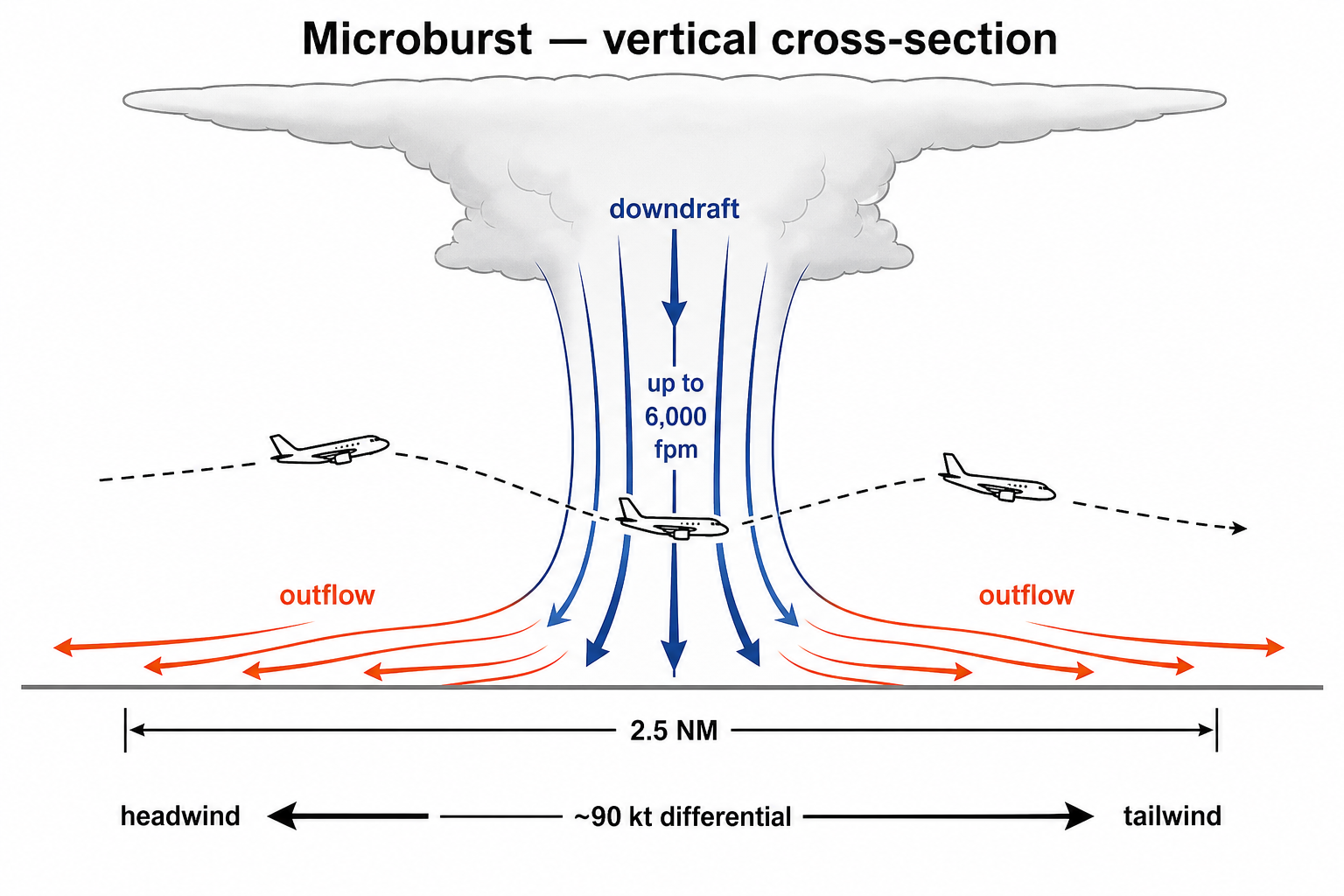
A microburst is a small, intense downburst that creates strong, often damaging surface winds. Per AC 00-54 and the AIM 7-1-26:
- Diameter: typically < 2.5 NM at the surface
- Lifespan: < 15 minutes total; intense phase often only 5
- Vertical wind: downdrafts up to 6,000 fpm
- Headwind/tailwind differential: up to 90 kt across the cell
- Wet vs dry: wet microbursts visible with rain shaft; dry microbursts develop from high-based cumulus with virga only — virtually invisible until you're in it
The classic accident sequence: aircraft on approach hits the leading-edge headwind (airspeed spike, climbs above glide path), pilot reduces power to correct, aircraft transits the downdraft and exits into the trailing tailwind (airspeed collapses), aircraft now low + slow + reduced power. This is why the canonical recovery rule is "do not chase airspeed."
If suspected — recovery technique
Per AC 00-54:
- Maximum power — collective up to torque/EGT limit, fixed-wing equivalent is firewall thrust.
- Pitch for best climb attitude, not best climb airspeed. Hold the attitude even as airspeed wanders.
- Do not chase airspeed — pilots who pitch down to recover lost airspeed feed altitude into the microburst.
- Communicate — declare the encounter, request priority, deviate.
If you see a low-level wet microburst on approach, the correct action is to not be there — go around early and reposition.
Helicopter exposure — why we are extra-vulnerable
- Helicopter operations include hovering and slow flight at exactly the altitudes microbursts dominate (surface to ~1,000 ft).
- Light helicopters have lower mass and less momentum to ride through a downdraft — you don't punch through, you sink with it.
- Downdrafts over forested areas can be strong enough to force a helicopter into the trees even at best rate-of-climb airspeed and full power.
- External-load operations and confined-area approaches put you in slow flight with limited maneuver options — exactly the wrong place when shear arrives.
- Helicopters cannot use airline-style escape vectors at altitude; the shear envelopes the entire approach.
Detection & warning systems
- LLWAS (Low-Level Wind Shear Alert System) — surface anemometer network at large airports; tower issues alerts to pilots
- TDWR (Terminal Doppler Weather Radar) — automated microburst detection at TDWR-equipped airports; alerts include "Microburst Alert, expect 40-knot loss on 3-mile final"
- PIREPs — by far the best low-altitude warning. Listen on tower freq during convective weather.
- Visible cues — virga (rain falling but not reaching ground), dust ring on the surface (microburst foot), localized rain shaft